Studying
Religion in
Culture

Faculty & Staff
About Us
Degrees
Courses

Events
Links
Contact

UA Home
Students' Desk
Home


Religion in Culture Lecture

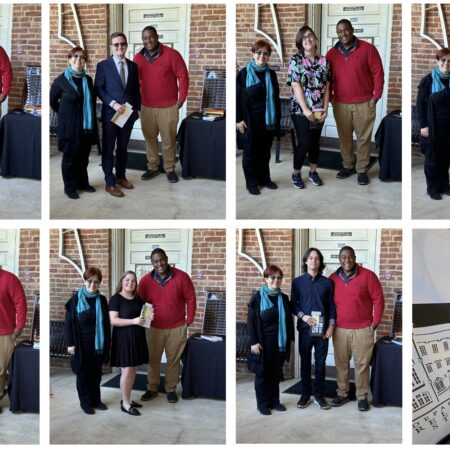
On January 22, 2004, Mindy Nancarrow (pictured far left, with William Dooley, Chair, Art Department), Professor of Art History at the University of Alabama, delivered a lecture entitled, "Between the Book and the Basket: Structuring the Virgin in Spanish Age Art."

Professor Nancarrow--whose specialty involves the study of both baroque and contemporary art--received her Ph.D. in art history from the University of Kansas. Her prize-winning first book, which arose from research carried out for her doctoral dissertation on the Spanish artist Bartolome Esteban Murillo (1617-1682), is entitled Murillo's Allegories of Triumph and Salvation: The Life of Jacob and the Prodigal Son (1992). A second book, co-written with Benito Navarette Prieto and due to be published in Spain later this year, is devoted to the work of Antonio del Castillo (1616-1668), an artist from Cordoba. Its Spanish title is Antonio del Castillo y Saavedra: Su vida y su obra.

Dr. Nancarrow's "Religion in Culture" lecture concerned 17th C. Spanish devotional art depicting the annunciation of Mary (i.e., the Archangel Gabriel's announcement to Mary that she was to be the mother of Jesus). Mary is often pictured as learning the news with a book at hand--the assumption being that Mary was engaged in devotions when joined by Gabriel. For example, consider the work of Bernardo Strozzi (1581-1644; left).

But, in 17th C. Spanish art a woven basket often joins the book in paintings of the Virgin Mary. Drawing on examples from the work of such artists as Murillo and Francisco de Zurbaran (1598-1664), Professor Nancarrow argued that the presence of the book and the basket presented viewers with somewhat conflicting images. The use of the former (i.e., the practice of reading and studying texts) was generally limited to the domain of males at this time, whereas during this period the latter signified the domestic domain of women (i.e., sewing baskets bearing fabric and needles).

Professor Nancarrow examined Murillo's "St. Anne Teaching the Virgin to Read" (c. 1650; left), in which the sewing basket (foreground, lower left) and book are both prominent, along with cherubs. She noted that while it was widely presumed by Christian scholars of this era that Mary was born with all of her wisdom intact, it was her discipline and devotion that was being symbolized in this portrait of submission to her mother's instruction in how to read.

She also discussed Zurbaran's "The Young Virgin" (1632-3; left), in which the basket is featured in the right foreground and the small devotional book rests on the table to the left. The young, Mary sits with a sewing pillow on her lap while contemplating, with cherubs surrounding her head. The placement of the basket, Dr. Nancarrow noted, suggests that the viewer might identify with it, since it represents more mundane concerns.

Given that the Virgin Mary has been widely used throughout the history of Roman Catholic Christianity as a model for the social expectations placed upon women, Professor Nancarrow concluded that the book and the basket--symbolizing devotional expertise and discipline, on the one hand, and practical domestic productivity, on the other--functioned in 17th C. art as effective symbolic ideals for Spanish women.

Following Professor Nancarrow's "Religion in Culture" lecture, a small reception was held on the balcony of Manly Hall. The reception coincided with the unveiling of the new Department banner, which was installed earlier that day.

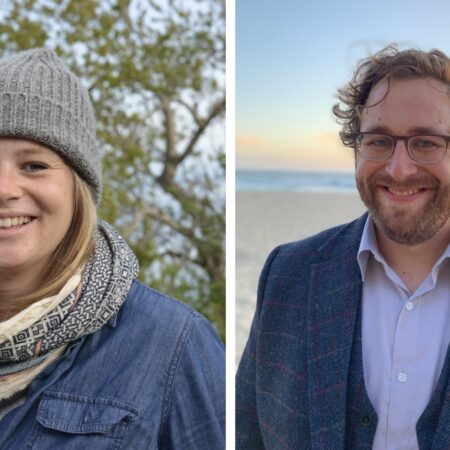
Pictured above left are Professors Fassbeck and Shaeffer, outside the Department's main office. Picture above right are Religious Studies majors Tim Baines and Drew Elmore along with Professors Fassbeck and Jacobs.


The "Religion in Culture" Lecture Series is made possible through the generosity of the College of Arts & Sciences' Anonymous Lecture Fund.

As always, our thanks to Prof. Ted Trost (pictured left, introducing Prof. Nancarrow) who, along with the assistance of Betty Dickey and Donna Martin, organizes all of our Department's public lectures.

For a list of upcoming public lectures sponsored by the Department, please visit our Events page.